The Break Room Price Index | What Things Cost Now vs. Ten Years Ago (and the One Price That Never Moved)
Oct 22

The Break Room Price Index
What Things Cost Now vs. Ten Years Ago (and the One Price That Never Moved)
Ten years ago, a lot of us were new grads, new to a unit, or new to night shift and still convinced we'd "get used to it." We were also paying a lot less for almost everything. Somewhere between then and now, the drive-thru total started looking like a copay, and filling the tank started to feel like a procedure that should require informed consent.
So we did what nurses do. We took a set of vitals. Here's the Break Room Price Index: four everyday costs, then and now, with real numbers from real sources. They're listed at the bottom, because if it isn't documented, it didn't happen.
So we did what nurses do. We took a set of vitals. Here's the Break Room Price Index: four everyday costs, then and now, with real numbers from real sources. They're listed at the bottom, because if it isn't documented, it didn't happen.
Gas: Trending Up, Notify Provider
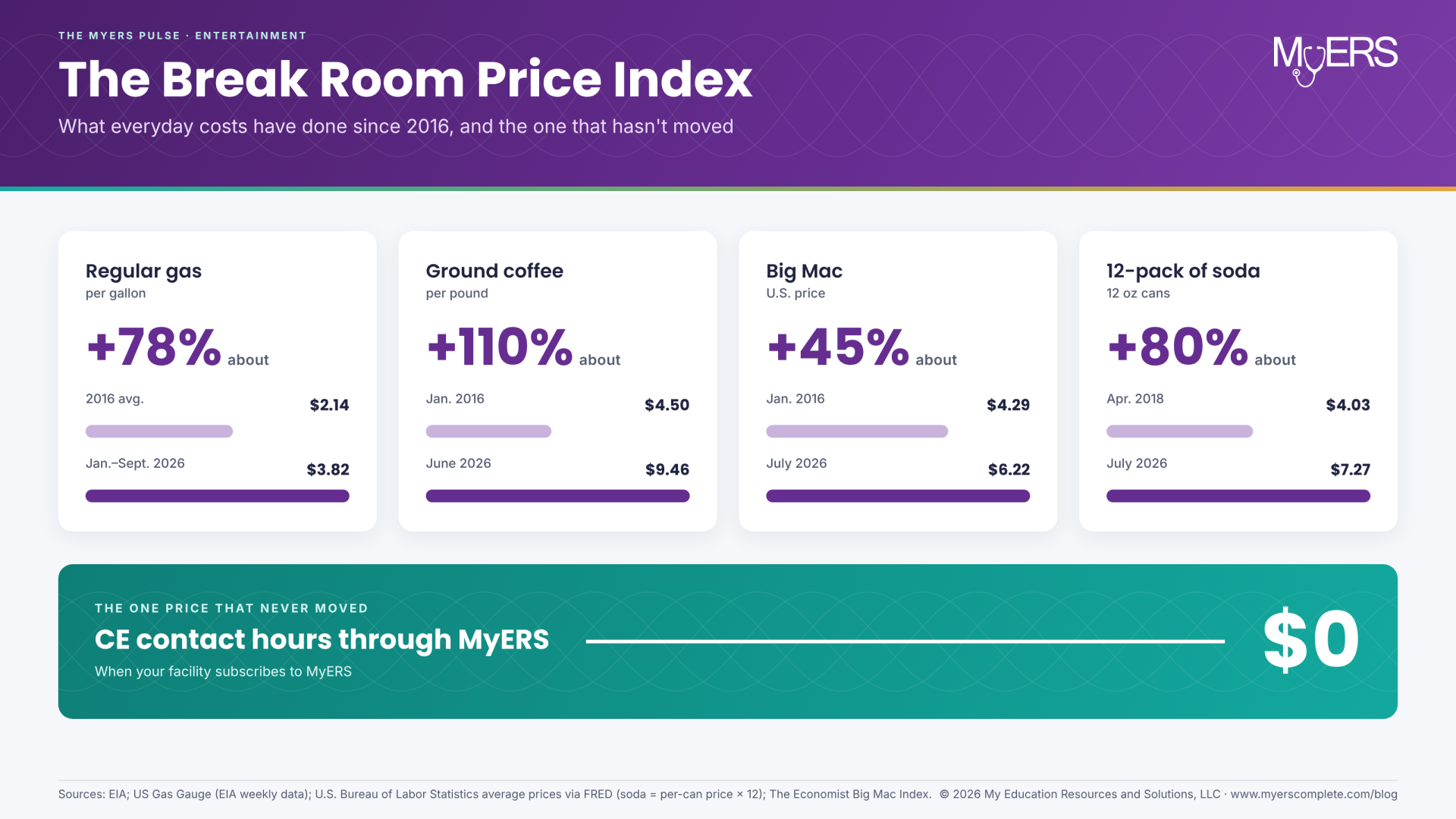
In 2016, a gallon of regular gasoline averaged about $2.14 nationally, according to the U.S. Energy Information Administration. For January through September 2026, the average of EIA's weekly prices comes to about $3.82, according to US Gas Gauge. That's roughly 78 percent higher. And a single day can look even worse. AAA reported a national average of $4.41 on October 1, 2026, and put September's monthly average at $4.33, which AAA called a record for September.
For nurses, gas isn't optional. Many of us commute a long way to the hospital we actually want to work at, float between campuses, or spend the whole shift driving between home health visits. And twelve-hour shifts don't come with a bus schedule that runs at 6:45 in the morning and 7:30 at night.
Coffee: The Real Life Support
On most units, coffee is practically a clinical necessity, and it has gotten a lot more expensive. According to the Bureau of Labor Statistics, a pound of 100% ground roast coffee averaged about $4.50 in January 2016. By June 2026, it averaged about $9.46, more than double. And we won't even talk about what your venti order costs now. Brewing at home and filling a travel mug before shift is one of the easiest ways to take some pressure off the budget.
The Big Mac: A Post-Shift Classic
The Economist has tracked the price of a Big Mac for decades as a lighthearted way to compare currencies around the world. It works just as well for measuring heartbreak at home. In January 2016, a Big Mac in the United States cost $4.29. By July 2026, it was $6.22, about 45 percent more. The drive-thru stop on the way home from a night shift has quietly become a budget line item.
The 12-Pack of Soda: Caffeine Is a Fixed Cost
The Bureau of Labor Statistics didn't start tracking the average price of soft drinks sold in 12-packs of 12-ounce cans until 2018, so this one gets an eight-year look instead of ten. BLS reports the price per can, so we multiplied by 12 to get the cost of a pack. In April 2018, the average was $0.336 a can, or about $4.03 for a 12-pack. By July 2026, it was $0.606 a can, or about $7.27, an increase of about 80 percent. BLS notes that its average prices are best for comparing price levels rather than measuring precise inflation, so think of this as a snapshot. That figure covers all soft drinks rather than one brand, but whether your unit runs on Diet Coke, root beer or something with "energy" on the label, restocking the break room fridge costs a lot more than it used to.
Budgeting Moves That Fit a Nurse's Schedule
Most budgeting advice assumes a Monday-through-Friday life with the same paycheck every two weeks. Ours looks different. Here are a few moves that work with rotating shifts, differentials and the occasional 3 a.m. craving.
-
Budget on base pay. Shift differentials, overtime and call pay make paychecks bumpy. Build your essential budget on base pay alone, and give every extra shift a job before it lands, whether that's debt, savings or a planned splurge.
-
Fuel up on your days off. Filling the tank at the end of a 12 usually means the closest station at whatever price it's charging. A price-comparison app and a fill-up on your day off can take some of the sting out of those gas numbers.
-
Pack the night-shift meal before the craving hits. The drive-thru wins when you're tired and hungry. A meal packed before your shift and a snack stash in your locker are the best defense against the $6.22 burger.
-
Buy break room drinks in bulk and on sale. Some units pool money for a shared drink and snack stock. It saves money, and it means nobody has to make an emergency vending machine run with the call lights going.
-
Audit your subscriptions on your next stretch off. Streaming services, apps and memberships you signed up for during a rough week add up quietly.
-
Use the benefits you already have. Retirement match, tuition reimbursement and employee assistance programs (some offer free financial counseling) are money left on the table if you don't use them. So is free continuing education.
The One Price That Hasn't Moved
Every nurse knows the license renewal math. You need contact hours, there's a deadline, and somehow it always arrives faster than expected. Paying out of pocket for CE is one more cost on a list that keeps getting longer.
Here's the line item that isn't going anywhere: when your facility subscribes to MyERS, the price you pay for each CE contact hour you earn is $0. Pass a MyERS competency assessment and you earn 1.0 contact hour, at no charge to you. Contact hours are available for RNs, APRNs, LPNs and CNAs, and MyERS is an approved provider of continuing education by the Florida Board of Nursing (CE Broker Provider #50-4366).
Gas, rent, burgers and soda all went up. Your CE cost stayed flat. In this index, it's the only flatline you'll be happy to see.
Sources used
- The Economist, Big Mac Index raw data, U.S. prices January 2016 and July 2026
- U.S. Energy Information Administration, Monthly Energy Review, Table 9.4, retail motor gasoline prices (2016 annual average)
- US Gas Gauge, "Gas Prices in 2026 So Far" (average of EIA weekly prices, first 39 weeks of 2026)
- AAA, "National Average Dips Following Record-Setting September" (October 1, 2026)U.S. Bureau of Labor Statistics, Average Price: Coffee, 100%, Ground Roast, All Sizes (Cost per Pound), U.S. City Average (series APU0000717311), via FRED
- U.S. Bureau of Labor Statistics, Average Price: All Soft Drinks, 12 Pk, 12 Ounce, Cans (Cost per 12 Ounces), U.S. City Average (series APU0000FN1102), via FRED

Explore
-
About
-
Education Resources
-
Solutions
-
Pricing
-
Staff Login Page
-
New CE Programs
-
Referral Reward/Discount
Contact
-
My Education Resources and Solutions, LLC
-
PO Box 39566
Greensboro, NC 27438 -
hello@myerscomplete.com
-
(336) 988-7076
Become a member
Your gateway to advanced, cloud-based CE solutions.