
The CDC Just Rewrote History on Vaccines and Autism | Let's Talk About It, Nurse to Nurse
Jul 27
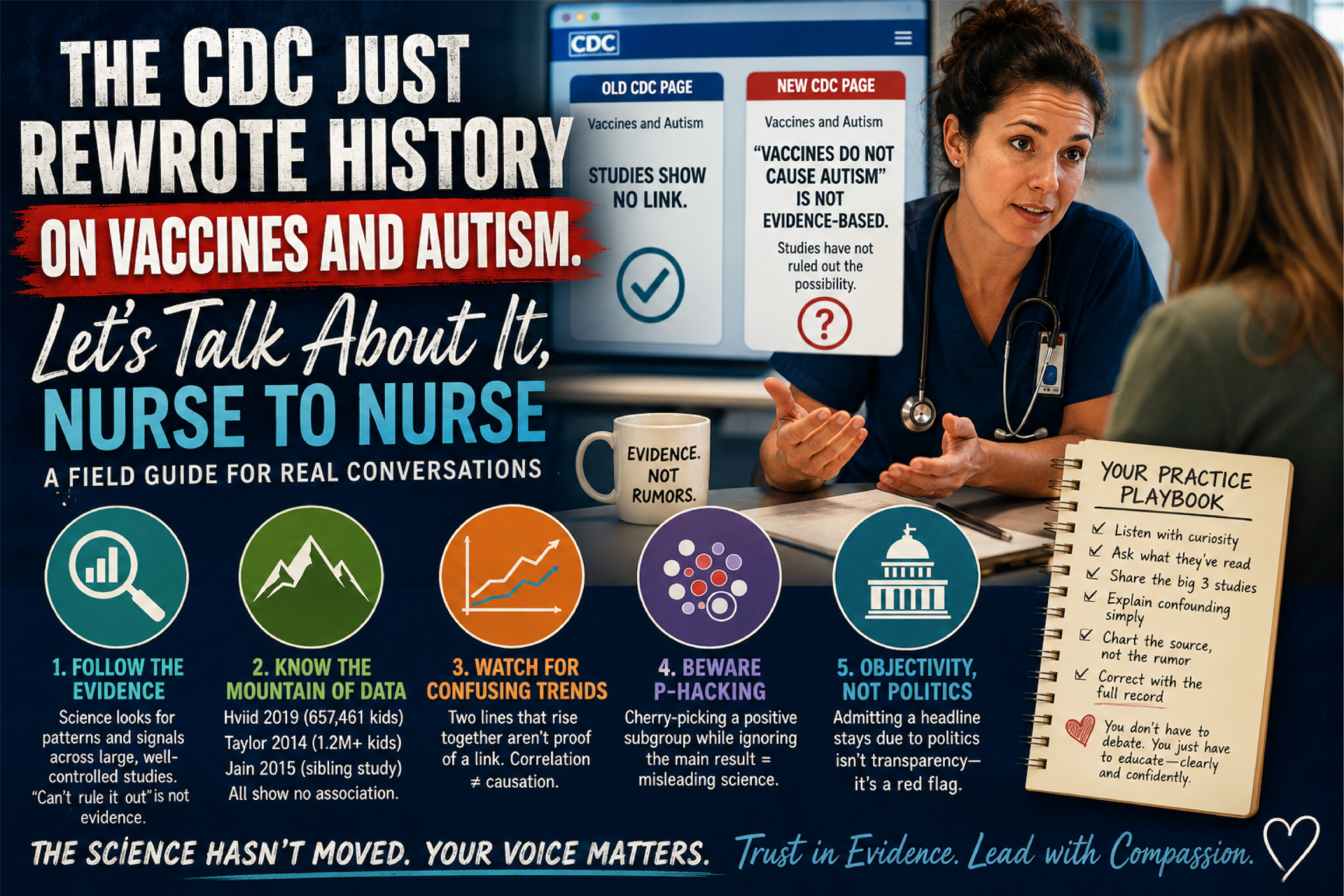
The CDC Just Rewrote History on Vaccines and Autism
Let's Talk About It, Nurse to Nurse
A field guide for anyone who's about to get "but I read it on the CDC website" at triage, at the well-child visit, or at Thanksgiving dinner.
In November 2025, updated July 22, 2026, the CDC quietly rewrote its own "Vaccines and Autism" page. The old version said plainly: studies show no link. The new version says the opposite claim - "vaccines do not cause autism" - is "not evidence-based," because studies haven't ruled out the possibility.
Same agency. Same evidence base. Opposite conclusion. That should set off every alarm bell you were trained to listen for, and not because the underlying science changed - it didn't. What changed is the argument. So let's do what nurses do best: read the chart critically before we act on it.
In November 2025, updated July 22, 2026, the CDC quietly rewrote its own "Vaccines and Autism" page. The old version said plainly: studies show no link. The new version says the opposite claim - "vaccines do not cause autism" - is "not evidence-based," because studies haven't ruled out the possibility.
Same agency. Same evidence base. Opposite conclusion. That should set off every alarm bell you were trained to listen for, and not because the underlying science changed - it didn't. What changed is the argument. So let's do what nurses do best: read the chart critically before we act on it.
Problem #1: You can't "rule out" anything in science - that's the whole point
The page's central move is demanding proof of a negative. But science doesn't work that way, and it never has. Nobody can "rule out" that your morning coffee causes autism either. What researchers can do - and have done, exhaustively - is look for a dose-response signal, a plausible biological mechanism, and a statistical association across huge, well-controlled populations, and repeatedly come up empty.
That's not "no evidence." That's the strongest kind of evidence science produces. Reframing "we searched hard and found nothing" as "unproven" is the identical rhetorical move the tobacco industry used for forty years: no study has definitively proven cigarettes cause cancer in this specific patient. It's technically unfalsifiable and clinically useless.
That's not "no evidence." That's the strongest kind of evidence science produces. Reframing "we searched hard and found nothing" as "unproven" is the identical rhetorical move the tobacco industry used for forty years: no study has definitively proven cigarettes cause cancer in this specific patient. It's technically unfalsifiable and clinically useless.
Problem #2: The "no studies" claim skips past a mountain of them
The page leans on 1991 and 2012 Institute of Medicine language calling evidence "inadequate" for the pertussis-containing vaccines specifically - then quietly generalizes that into "vaccines" as a category. But for MMR, the vaccine parents worry about most, the evidence is not thin. It's some of the largest cohort data in vaccine safety history:
-
Hviid et al., 2019 (Annals of Internal Medicine) - 657,461 Danish children followed for over a decade. No increased risk of autism, including in children with autistic older siblings, the exact "high-risk" subgroup a real biological link should show up in.
-
Taylor, Swerdfeger & Eslick, 2014 (Vaccine) - meta-analysis covering more than 1.2 million children. No association.
-
Jain et al., 2015 (JAMA) - US sibling study specifically designed to catch a genetic-susceptibility mechanism. Nothing.
The CDC page mentions some of this and waves it off as "serious methodological limitations." It does not mention the scale.
Problem #3: The correlation chart is Statistics 101 bait
"Autism rates rose as the vaccine schedule grew" is the kind of graph that looks damning until you remember two rising lines will always correlate. Autism diagnoses also climbed in lockstep with organic produce sales, smartphone adoption, and Netflix subscriptions - because all of them are secular trends over the same 40 years.
The real driver is boring and well-documented: DSM-IV and DSM-5 broadened diagnostic criteria, screening became routine at well-child visits, awareness grew, and diagnostic substitution happened (kids once coded "intellectual disability" are now correctly coded autistic). None of that needs a vaccine mechanism. If you've ever explained confounding to a patient with a home blood pressure log, you already know this instinct.
The real driver is boring and well-documented: DSM-IV and DSM-5 broadened diagnostic criteria, screening became routine at well-child visits, awareness grew, and diagnostic substitution happened (kids once coded "intellectual disability" are now correctly coded autistic). None of that needs a vaccine mechanism. If you've ever explained confounding to a patient with a home blood pressure log, you already know this instinct.
Problem #4: The aluminum claim is a p-hacking demonstration
This is the one to actually get mad about. The page cites a large Danish aluminum-adjuvant study - then skips its primary finding (no increased neurodevelopmental risk) to surface a single positive result buried in a supplementary subgroup table: a "67% increased risk of Asperger's per 1 mg of aluminum."
Here's the tell: slice one big dataset into enough subgroups, and by chance alone, some of them will cross p<0.05 - the same way flipping enough coins eventually gets you ten heads in a row. Reporting the one buried positive subgroup while soft-pedaling the negative headline result is a textbook multiple-comparisons problem. It's the kind of thing that gets a paper rejected in journal club, not published on a federal agency's homepage.
Here's the tell: slice one big dataset into enough subgroups, and by chance alone, some of them will cross p<0.05 - the same way flipping enough coins eventually gets you ten heads in a row. Reporting the one buried positive subgroup while soft-pedaling the negative headline result is a textbook multiple-comparisons problem. It's the kind of thing that gets a paper rejected in journal club, not published on a federal agency's homepage.
Problem #5: It says the quiet part out loud
The page keeps its old header - "Vaccines do not cause Autism" - with an asterisk. Follow the asterisk and it explains the header wasn't removed because of a political agreement with the chair of the Senate HELP Committee, not because the evidence supports it. A page invoking the Data Quality Act's demand for "objectivity" is, in the same breath, admitting its own headline is a political IOU. As Alison Singer of the Autism Science Foundation put it: you can't run a study to prove something doesn't cause something else - that's not how science works, in either direction.
What this actually means for your practice
-
The talking point will show up everywhere - pediatrics, family med, even geriatrics, once patients extend "the CDC is unsure about vaccines" to flu, shingles, RSV, and COVID boosters. Vaccine trust doesn't erode in neat, disease-specific silos.
-
"No studies prove X doesn't happen" is a script, not a fact - you'll hear a version of it at every age of the lifespan now. Recognizing the pattern (impossible-standard-of-proof) is more useful than memorizing a rebuttal for each vaccine.
-
Lead with curiosity, not confrontation. Motivational interviewing beats a lecture: "What have you read that's worrying you?" opens more doors than "that's not true."
-
Know your three studies. Hviid 2019, Taylor 2014, Jain 2015 (the sibling study especially lands well with hesitant parents) - you don't need footnotes at the bedside, just the shape of the evidence.
-
Chart it like you'd chart any other bad data point - note where it came from, don't repeat it as fact, and correct it with what the full record actually shows.
Here's the part worth sitting with: not one study, not one data point, not one number changed on July 22. The evidence base is the same evidence base it was the day before. What changed was the wording - five careful sentences engineered to sound like caution and function like doubt. That's not a scientific update. It's a script.
So when a patient sets that page down in front of you - and they will - you're not starting from zero. You already know the five moves: the impossible-proof demand, the buried studies, the correlation sleight of hand, the p-hacked aluminum subgroup, the political asterisk. Name the trick, then hand them something sturdier than a screenshot: the actual evidence, in language that respects both their worry and their intelligence. That's the job. You're ready for it.

Explore
-
About
-
Education Resources
-
Solutions
-
Pricing
-
Staff Login Page
-
New CE Programs
-
Referral Reward/Discount
Contact
-
My Education Resources and Solutions, LLC
-
PO Box 39566
Greensboro, NC 27438 -
hello@myerscomplete.com
-
(336) 988-7076
Become a member
Your gateway to advanced, cloud-based CE solutions.